
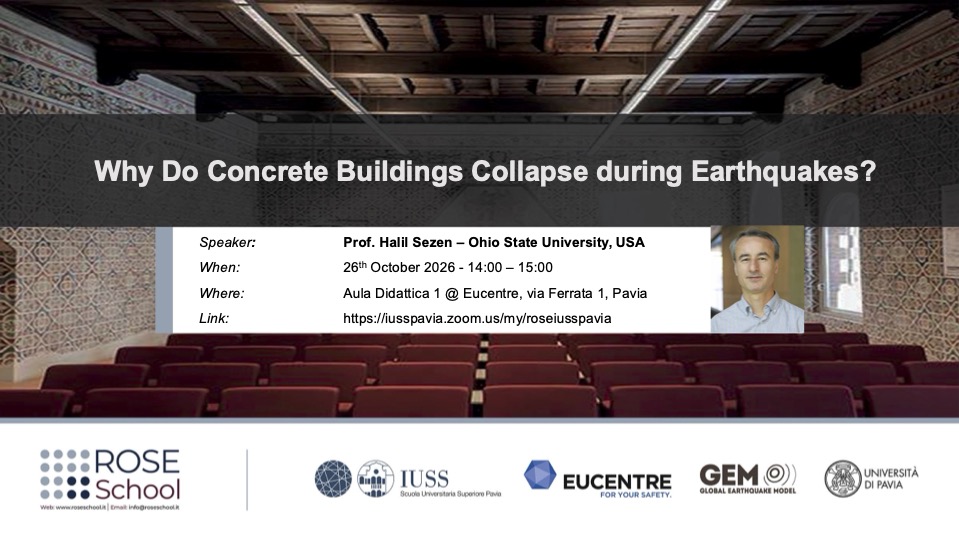
Why do reinforced concrete buildings collapse during earthquakes? Prof. Halil Sezen, professor of structural engineering at The Ohio State University, will address the question in a ROSE lecture on Monday 26 October 2026, from 2.00 to 3.00 pm (1.00 pm in the United Kingdom), in Aula Didattica 1 at the Eucentre Foundation, via Ferrata 1, Pavia. The seminar can also be followed via live streaming on Zoom.
Which factors make reinforced concrete buildings collapse during earthquakes?
Prof. Sezen will present the main factors behind the collapse of reinforced concrete buildings under lateral and gravity loads, and will briefly discuss how slabs and diaphragms, beams, beam-column joints, columns and foundations each contribute to the performance of the frame system. He will also review the insufficient steel reinforcement details commonly observed in structural components. According to the abstract, ductility, interconnectivity and redundancy are critical for transferring and redistributing loads after a member fails.
Why are columns so important in building collapse?
The abstract identifies insufficient column design and detailing as one of the main reasons buildings collapse. The lecture therefore focuses on two failure modes: shear failure, which concerns the resistance of a column to lateral forces, and gravity load collapse, which concerns its ability to keep supporting vertical loads.
What evidence will the lecture present?
Prof. Sezen will draw on building failure examples from recent earthquakes and other extreme events, on laboratory tests of columns with examples from the field, and on field experiments in which first-storey columns were physically removed from actual buildings on the Ohio State University campus. The laboratory and field evidence is intended to demonstrate the importance of steel reinforcement detailing in structural design, and the results of the campus experiments will be presented.
Who is Prof. Halil Sezen?
Halil Sezen is a professor in the Department of Civil, Environmental and Geodetic Engineering at The Ohio State University. He obtained his PhD from the University of California at Berkeley in 2002 and was president of the Structural Engineers Association of Ohio (SEAoO) in 2023. A fellow of the American Concrete Institute (ACI) and of the American Society of Civil Engineers (ASCE), he has served on technical committees of ACI, ASCE, the Earthquake Engineering Research Institute (EERI) and the Precast/Prestressed Concrete Institute (PCI). He is co-chair of the Housing subcommittee of EERI’s Learning from Earthquakes programme.