
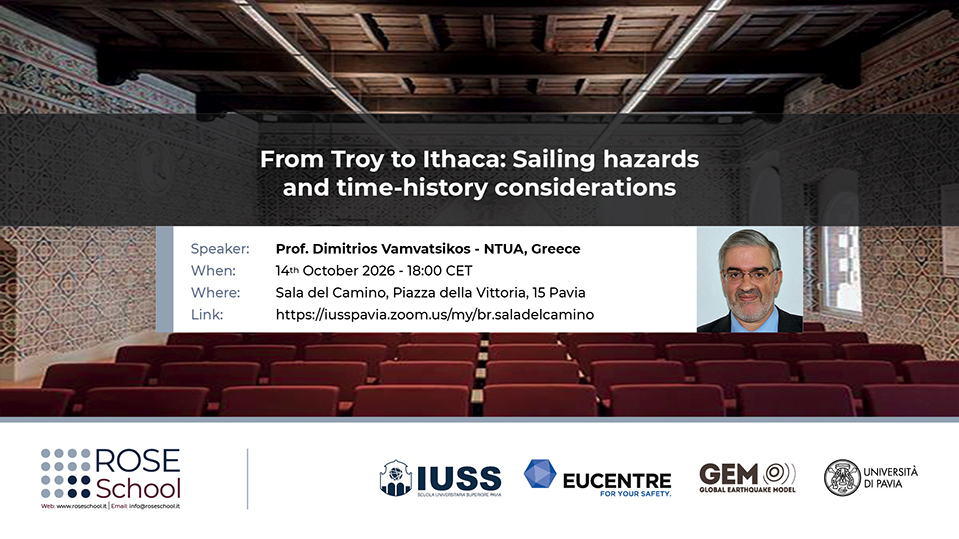
On Wednesday 14 October 2026 at 18:00 Italian time (CEST), the ROSE School hosts a seminar by Prof. Dimitrios Vamvatsikos of the National Technical University of Athens (NTUA), Greece. The seminar is entitled “From Troy to Ithaca: Sailing hazards and time-history considerations“. It takes place in the Sala del Camino, Piazza della Vittoria 15, Pavia, and can also be followed online via Zoom at https://iusspavia.zoom.us/my/br.saladelcamino. The event is promoted with ROSE School, IUSS Pavia, Eucentre Foundation, GEM Foundation and the University of Pavia.
A Homeric journey as a lens on risk
The seminar opens with the aftermath of the Trojan War. Having left Troy in ruin, the Greek heroes began their journeys home, each with his own ships, spoils and companions. For some the return took a few weeks. For Ulysses, who engineered the fall of the city and angered half the Greek Pantheon in doing so, it took ten years and cost him all his assets and every one of his companions.
This contrast carries a precise quantitative point. Under conventional risk assessment and the aggregate results it usually reports, loss of life on the homeward voyage was in the order of 1 to 2 percent, averaged over more than a thousand black ships. For those sailing with the twelve ships of Ulysses, the picture was very different: one man survived out of six hundred, a loss of 99.83 percent. A summary prepared according to standard practice would highlight the aggregate figure of 1 to 2 per cent and discard the case-specific figure of 99 per cent.
Why the sequence of events matters
Prof. Vamvatsikos asks whether this distinction makes any difference. For Agamemnon, commander of the expedition and concerned with overall losses, it does not. For a sailor from Ithaca it is decisive, since he would most likely have died. Each crew’s sailing time-history mattered. Its fate depended on the series of events it actually met: Scylla, the Cyclops and Circe on one route, a breezy and sunny crossing on another.
From this mythological premise, the seminar turns to contemporary structures in seismic areas and examines what causes them to lead a similarly Homeric existence. The discussion bears directly on earthquake engineering and risk assessment. Here, aggregate indicators may conceal the outcome for an individual structure, whose fate depends on the specific history of events it is exposed to over its life.