
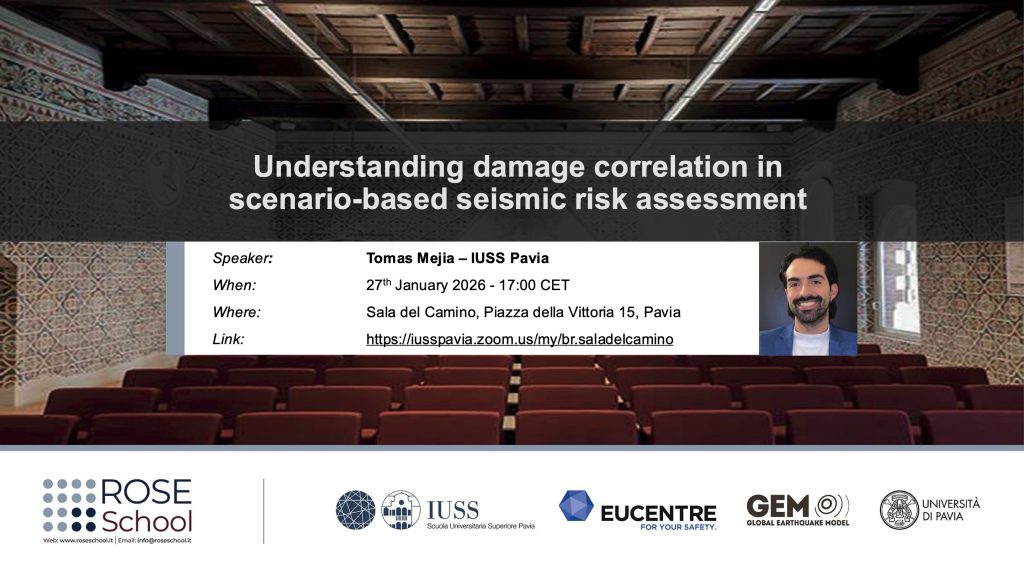
On January 27th, 2026, ROSE School will host another seminar dedicated to one of the critical and often underestimated aspects of modern seismic risk analysis: the correlation of structural damage and its implications for scenario-based risk assessment.
The seminar will be delivered by Tomas Mejia, PhD candidate in Earthquake Engineering (ROSE) at IUSS Pavia, and will take place in Sala del Camino, Palazzo del Broletto (Pavia), with the possibility to attend online.
A key challenge in seismic risk modelling
Scenario-based seismic risk assessment plays a central role in emergency planning, loss estimation, and decision-making processes at the regional and urban scales. While hazard, exposure, and vulnerability are well-established components of risk modelling, the spatial correlation of damage between neighboring structures is still frequently simplified or neglected.
However, observed earthquake damage patterns clearly show that building performance is not always independent in space. Local soil conditions, construction typologies, urban morphology, and shared structural characteristics generate clusters of damage that significantly influence aggregate losses and emergency response needs.
Neglecting these correlations may lead to biased estimates of damage, casualties, and economic losses, ultimately affecting the reliability of seismic risk scenarios used by civil protection authorities, policymakers, and infrastructure managers.
Seminar focus
The seminar, entitled “Understanding Damage Correlation in Scenario-Based Seismic Risk Assessment”, will explore:
- the physical and statistical origins of damage correlation;
- its impact on regional-scale vulnerability modelling;
- the consequences for scenario-based loss assessment;
- implications for risk-informed planning and mitigation strategies.
The presentation will outline a analytical framework, supported by recent research developments and applied modelling approaches.
About the speaker
Tomas Mejia is a PhD candidate in Earthquake Engineering (ROSE) at IUSS Pavia.
He graduated with honours in Civil Engineering from Universidad EIA (Medellín, Colombia) in 2019. He then worked for over three years as a structural engineer, contributing to the design of reinforced concrete, masonry, and steel buildings, as well as concrete storage tanks.
In 2024, he completed the ROSE curriculum within the Joint Master’s Programme in Civil Engineering for Mitigation of Risk from Natural Hazards, jointly offered by the University of Pavia and IUSS Pavia, graduating with honours. His current doctoral research focuses on the role of damage correlations in large-scale seismic risk modeling and scenario-based assessments.
Audience and relevance
The seminar is addressed to:
- researchers and PhD students in earthquake engineering and seismic risk;
- professionals working in risk assessment, civil protection and infrastructure resilience;
- practitioners involved in vulnerability modelling and disaster risk reduction.
The event is a great opportunity to learn more about a topic that is becoming increasingly important for developing better, stronger seismic risk scenarios.
ROSE School continues its seminar series to foster scientific discussion and knowledge exchange on advanced topics in earthquake engineering and risk mitigation.